VOLTIC CLOUD
Platform for operating EV charging networks
Manage charging stations, users, sessions, and billing across sites and brands - while Voltic Edge handles energy and safety locally.
Complete operational control, flexible monetization, and scalable network management - across sites and brands.
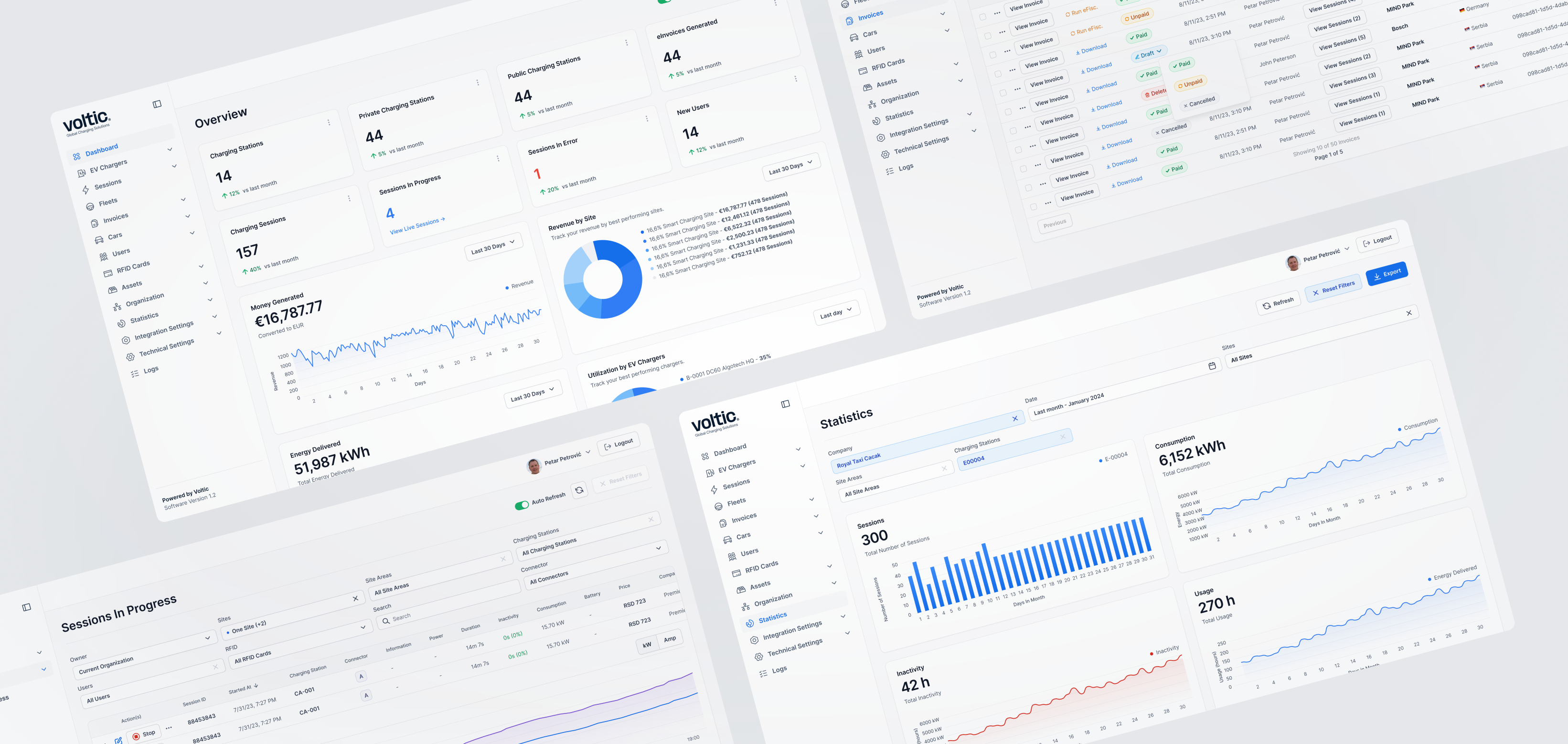

WHY VOLTIC CLOUD
Everything operators need to run a charging network
While Voltic Edge executes all safety-critical energy decisions locally, Voltic Cloud provides the tools operators need to manage charging as a business.
Centralized Management
Unified control across all charging stations, sites, and brands from a single platform.
Real-time Visibility
Live monitoring, diagnostics, and operational insights across your entire network.
Flexible Monetization
Configurable tariffs, payment flows, and billing models for any business case.
Scalable Operations
From single-site installations to large multi-location deployments.
Network Interoperability
Roaming integrations and cross-network compatibility with platforms like Hubject.
Data-Driven Decisions
Analytics, reporting, and exportable business intelligence across all KPIs.
PLATFORM MODULES
Explore Voltic Cloud
in detail
Each module is designed to work independently or together, supporting operators from single-site installations to large multi-location deployments.
Charging Station Management provides centralized control over all EV charging stations in the network, regardless of manufacturer or location.
It enables operators to:
All operational actions follow site power and safety constraints enforced locally, ensuring consistent and secure behavior across the infrastructure.
User & Fleet Management centralizes all user, driver, and vehicle-related operations.
The module supports:
This enables businesses and fleet operators to manage charging access, track usage, and apply policies across users and vehicles in a unified system.
Billing & Payments enables monetization and cost recovery across different charging business models.
Operators can configure flexible billing logic, including:
The system supports different payment workflows, such as:
Voltic Cloud also supports integration with external payment providers and invoicing systems.
The system supports different business models, from public charging to internal cost allocation for fleets and corporate users.
Analytics & Reporting provides deep visibility into charging operations, energy usage, and revenue performance across stations, sites, and brands.
Operators can access:
This supports informed decision-making, operational optimization, and scalable reporting across multi-site deployments.
EV Roaming enables interoperability between charging networks.
The module supports:
Supported roaming integrations are available - including Hubject.
This allows operators to expand reach and improve user accessibility without duplicating infrastructure.
Payment Terminals enable direct, card-based payment at charging locations without requiring user registration, mobile applications, or prior setup.
Users can initiate and pay for charging sessions using a standard bank card directly at the charging station.
The module supports:
Payment terminals can be fully branded and customized to match the partner's identity (logo, colors, UI flow), ensuring a consistent on-site experience.

Voltic Cloud enables operators to manage and monetize charging infrastructure across locations and brands - with full visibility, control, and monetization.
Together with Voltic Edge, it forms a complete platform for scaling EV charging without grid upgrades or operational complexity.

PLATFORM ARCHITECTURE
While Voltic Edge handles energy -
Voltic Cloud handles operations
Voltic combines two tightly integrated systems:
Voltic Edge (EMS)
Runs within the electrical infrastructure and controls load management, power optimization, and energy limits. Operates independently of cloud connectivity.
Explore Voltic EdgeVoltic Cloud (CPMS)
Provides monitoring, configuration, analytics, billing, and multi-site management. Enhances visibility but does not control energy logic.
Explore Voltic CloudThis separation ensures safe operation even during connectivity loss. When connectivity is available, the cloud reflects operational data and configuration across the platform. If connectivity is lost, on-site control continues to enforce site limits and keeps charging operations stable and safe.
See it in action - U Center 2 in Bucharest runs 56 stations under fixed power limits with Voltic.
Read the case studyMake it yours, launch a fully branded charging platform.
Explore White-Label