Blog
Your Building Will Need EV Chargers by 2027. Here Is How to Prepare.
From 2027, EPBD requires EV charging in commercial buildings. See what the directive demands and how to comply without a costly grid upgrade.
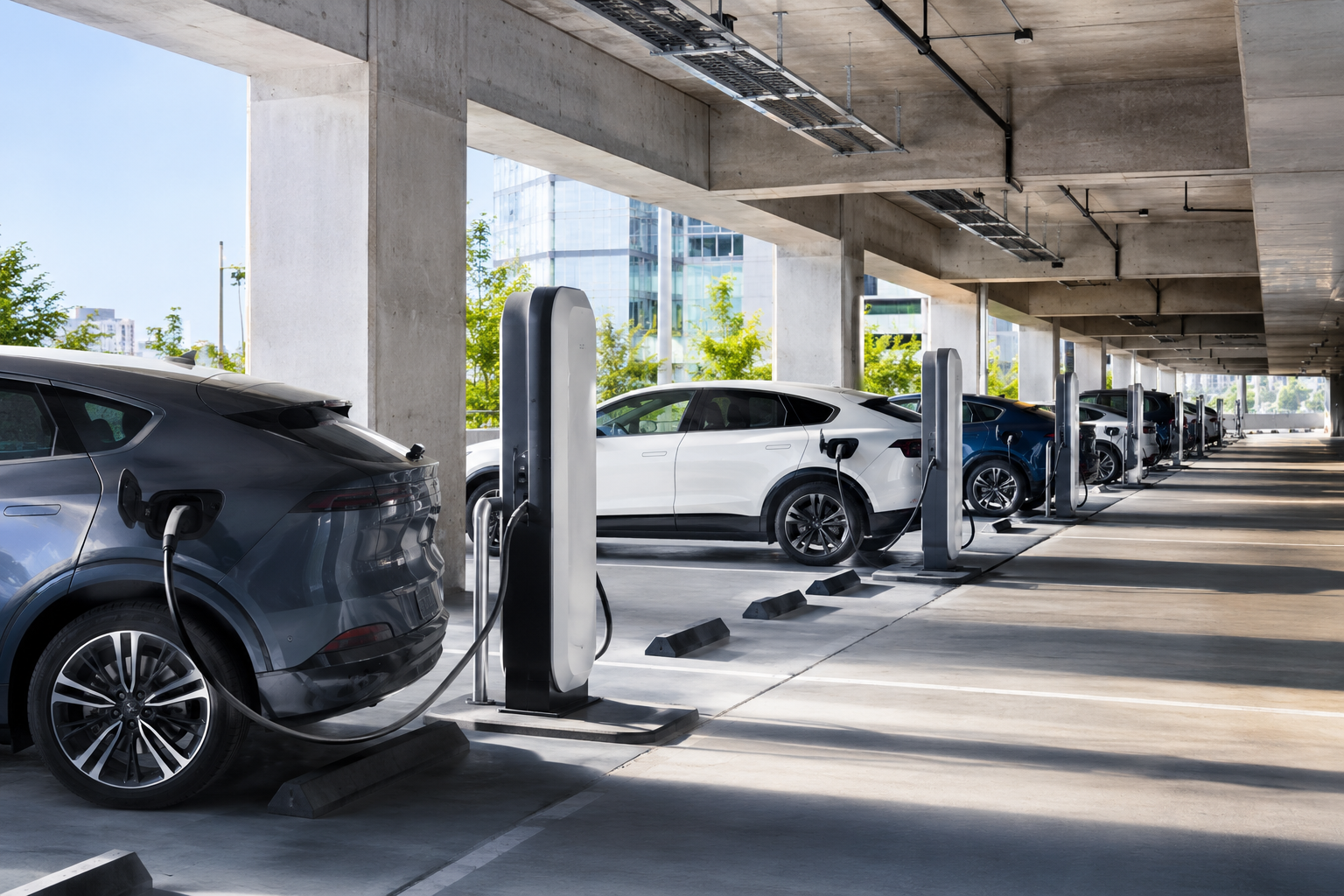
If you own or manage a commercial building, a new rule now affects your property. Under the recast Energy Performance of Buildings Directive (EPBD), every existing nonresidential building with more than 20 parking spaces must, from January 1, 2027, provide either at least one electric vehicle (EV) charging point per ten parking spaces or the cabling for at least half of its spaces. The deadline for EU member states to write this into national law was May 29, 2026. New buildings and major renovations face stricter ratios that already apply today. This is not a distant proposal. It is a current obligation, and most building owners have not yet heard about it.
That last point is both the risk and the opportunity. Awareness of this requirement is still low, which means the owners who prepare early will be ahead of a rule their competitors are about to discover late, and they will meet it at a fraction of the cost of a last minute scramble. This guide explains what EPBD asks of your building, what it costs to wait, and how the requirement can be met without the expensive grid upgrade most owners assume it demands.
What EPBD actually requires
The Energy Performance of Buildings Directive is the European Union framework for making buildings more energy efficient. Its latest version, Directive 2024/1275, came into force in May 2024 and brought EV charging directly into building obligations. The logic is simple. As more drivers switch to electric vehicles, the places people park, namely offices, retail centers, business parks, and mixed use developments, have to be ready to charge them.
The directive sets different requirements depending on the building:
- Existing non residential buildings with more than 20 parking spaces: from January 1, 2027, at least one charging point per ten parking spaces, or pre-cabling (the ducting and conduit that lets chargers be added later) for at least 50 percent of spaces, with a minimum of one charging point.
- New non residential buildings and major renovations: at least one charging point per five parking spaces, plus pre-cabling for at least half of the spaces.
- New and renovated office buildings: the highest bar, at least one charging point per two parking spaces.
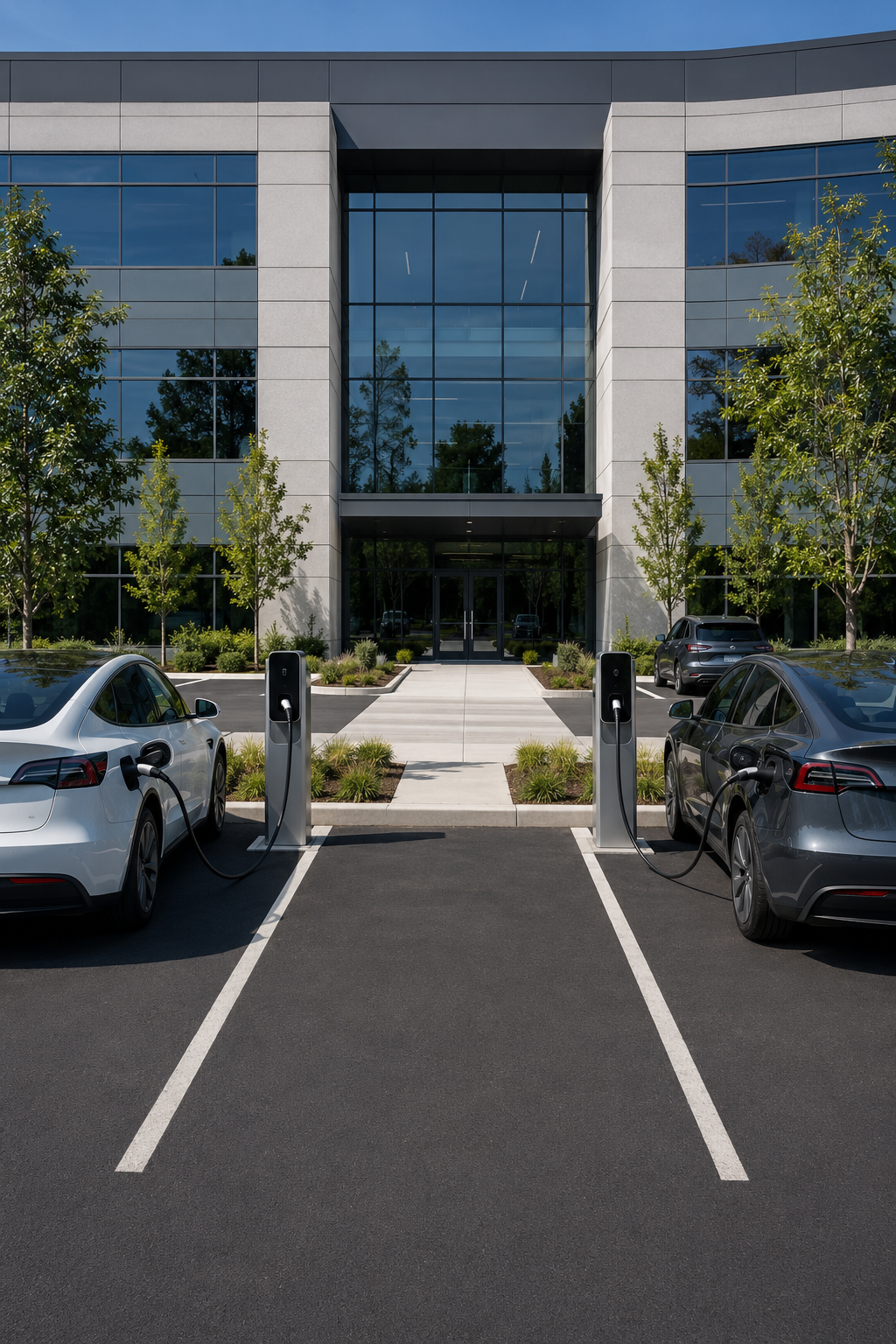
Every charger installed under these rules must support smart charging, meaning it can adjust how and when it draws power rather than pulling maximum load the moment a car plugs in. Keep that requirement in mind, because it turns out to be the part that saves owners the most money. We return to it below.
What this means for your building
The directive sets the floor. Each EU member state writes the detail into its own national law, and the specific text, incentives, and penalties vary from one market to the next. Some markets have already published implementation guidance; others are finalizing theirs now. For a property owner, the practical takeaway is the same everywhere: the direction is fixed and the obligation is coming, so the smart move is to prepare against the directive's requirements now and stay aligned as your national rules are published.
One point causes more confusion than any other, so it is worth stating plainly. January 1, 2027 is the start of the obligation, not a single deadline that comes and goes. A building that is not compliant by then remains obligated afterwards, and every new build or major renovation carries the requirement going forward. The market for compliant EV charging does not close in 2027. It opens.
The real cost of waiting
Most coverage of this directive stops at the requirements. The more useful question for an owner is what delay actually costs, and there are three answers.
The first is money. Pre-cabling a car park while it is being built or renovated is the cheapest moment to act. Retrofitting that same cabling later, by digging up surfaces and rerouting power, can cost several times more. An owner who folds EV readiness into work already underway pays a small fraction of what a standalone project will cost closer to the deadline.
The second is legal exposure. Compliance is a legal obligation, with enforcement and penalties set in national law. The specifics differ by market, but the principle is consistent across the EU: this is a requirement, not a recommendation.
The third, and the one most owners underrate, is commercial. EV charging has quietly become a factor in how buildings are valued and let. The Urban Land Institute has reported that EV charging can lift commercial property value, and a CBRE study found that close to half of building tenants see EV charging as a factor in their satisfaction with a location, while a large share now want green clauses written into their leases. Tenants are beginning to expect charging before they renew. A building that offers reliable EV charging is easier to let, easier to retain tenants in, and easier to value. A building that cannot is starting to look dated. Compliance, in other words, is turning into a leasing and asset value argument, not just a line on a checklist.
Smart charging is not just a rule. It is the solution.
Here is the part that changes how owners should think about the whole obligation.
When most building owners hear "install 20 or 50 charging points," they picture an enormous jump in electrical demand, and they assume the answer is a costly upgrade to their grid connection. That assumption is what makes the directive feel expensive and intimidating. It is also usually wrong.
The directive's requirement that every charger support smart charging is the way out. Smart charging, delivered through a local energy management system (EMS), means the building distributes the power it already has across the chargers that are active, instead of every charger demanding full power at once. Cars rarely all need a full charge at the same moment. A system that balances load in real time can run many chargers inside the building's existing power limit, shave the peaks that drive demand charges, and send power where it is needed most.
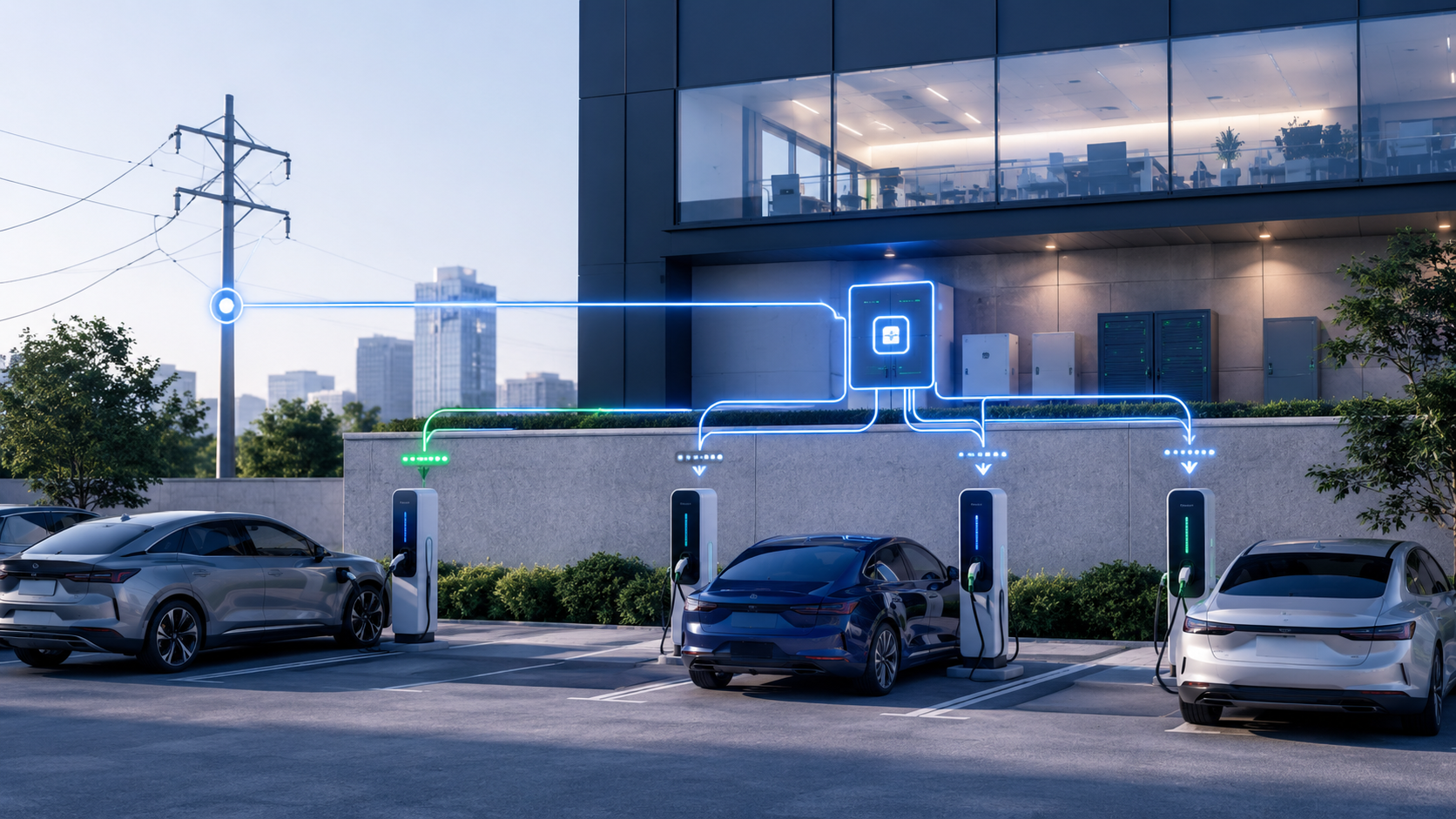
In other words, the rule that looks like an extra burden is the same mechanism that lets you meet the obligation without rebuilding your electrical infrastructure. This is the single most important point for a property owner to understand, and it is the point competing guides skip.
Proof from practice: charging at scale, no grid upgrade
This is not a theory. At U Center 2, a mixed use development, Voltic enabled 56 charging stations within the building's existing power capacity, with zero reported outages and no grid upgrade required. The site runs roughly 700 charging sessions a month and handles dozens of simultaneous sessions at peak, all kept safely inside the building's connection limit by a local energy management layer that makes the real time power decisions on site.
The detail worth holding onto is the headline outcome: a large charging deployment, delivered without the infrastructure overhaul owners fear. How the load is balanced second by second is the engineering story behind it, and one we are happy to walk through directly with owners who want the full picture.

Does this also cover public chargers?
A quick clarification, because owners often hear two rules at once and conflate them. EPBD governs the chargers your building must have. A separate regulation, the Alternative Fuels Infrastructure Regulation (AFIR), governs how chargers must work when they are open to the public, for example a shopping center car park or a hotel forecourt that visitors can use. If your chargers are private, for tenants and staff only, AFIR does not apply and EPBD is your focus. If your chargers are publicly accessible, AFIR adds payment and pricing requirements on top of the EPBD obligation. For most office and business park owners, EPBD is the rule that matters, and that is what this guide covers. We cover AFIR in a separate guide for owners whose sites include public charging.
A practical checklist: how to prepare from here
The obligation starts on January 1, 2027, which leaves a matter of months, not years. The good news is that you do not need to solve everything at once. You need to move through three stages, and the sooner you start the first, the more room you have to make good decisions rather than rushed ones.
Stage 1: Assess where your building stands.
- Count your parking spaces and confirm which EPBD category your building falls into (existing over 20 spaces, new build, or major renovation).
- Check your current grid connection capacity and how much of it is already committed.
- If a renovation is planned or underway, fold pre-cabling into it now, while it is by far the cheapest moment to act.
Stage 2: Decide your approach.
- Work out how many charging points you need to meet the ratio for your building type.
- Assess whether load management lets you stay inside your existing capacity, which it usually does, rather than applying for a grid upgrade.
- Plan for tenant cost allocation and access, so charging fits how the building already operates.
Stage 3: Implement and verify.
- Select a vendor agnostic system, so you are not locked to a single charger brand.
- Confirm the system runs critical energy decisions locally, so charging stays reliable even if the internet connection drops.
- Install, commission, and verify that load balancing keeps the site within its power limit under peak demand.
A building that begins Stage 1 today has time to reach Stage 3 calmly. A building that waits until late in the year will be making the same decisions under pressure, and often at higher cost.
How long does this take to put in place?
It takes less time than most owners expect, which is exactly why there is no reason to wait. A typical site goes from first conversation to a fully operating charging setup in 12 weeks or less, covering the assessment of your building, the design that keeps you inside your existing power capacity, installation, and commissioning. Because the heavy lifting is done by intelligent load management rather than new grid infrastructure, the timeline is driven by planning and installation, not by the long lead times and approvals that a grid connection upgrade would require. With the 2027 obligation only months away, several weeks is comfortably within reach for owners who start now, and increasingly tight for those who wait until the end of the year.
EPBD is being read as a cost, but for building owners it is really an opportunity to get ahead. The owners who prepare now will meet the requirement at a fraction of the cost of a last minute retrofit, and they will be able to offer something their tenants are already starting to ask for. The technology to do this within a building's existing power capacity and IT infrastructure already exists and is proven in practice. The only real risk is waiting.
What to do next
EPBD is moving from directive into national law across the EU, and the January 2027 obligation is closer than the date suggests. The buildings that prepare now will comply at the lowest possible cost and turn a requirement into a leasing and valuation advantage.
If you own or manage commercial property, the practical next step is a short conversation about your specific building: your parking count, your current power capacity, and what compliance looks like for you without a grid upgrade.
